Trombone History: Cherubs Playing the Trombone
Introduction
In visual art, a cherub, or more strictly speaking, a putto, is an infant or toddler, almost always male and with wings, found especially in Baroque art. So what are they doing playing trombones in Renaissance and Baroque art? The main reason probably goes to the religious associations of the instrument, the trombone being an instrument that for many years performed primarily in church settings. (For more background on the trombone's religious associations, and for full citations for all of the sources in this article, see Trombone History Timeline. See also Angel Trombonists Throughout History.) Although there are numerous examples of angel-trombonists in art, it is interesting to note just how many depictions feature cherub-trombonists, no less so because the trombone would seem to be a particularly difficult instrument for an infant to play! Below are several such images, along with background information on each.
1516—Freiburg, Germany: Hans Baldung’s painting, Coronation of the Virgin, the central panel of an altarpiece located in the Freiburg Cathedral, includes a cherub-trombonist among a group of angels playing wind instruments above and to the left of the Virgin. The other instruments being played in the wind instrument group appear to be crumhorn and either shawm or cornetto (see detail below; public domain) (Burkhard pl. 2).
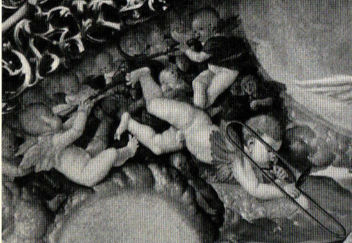
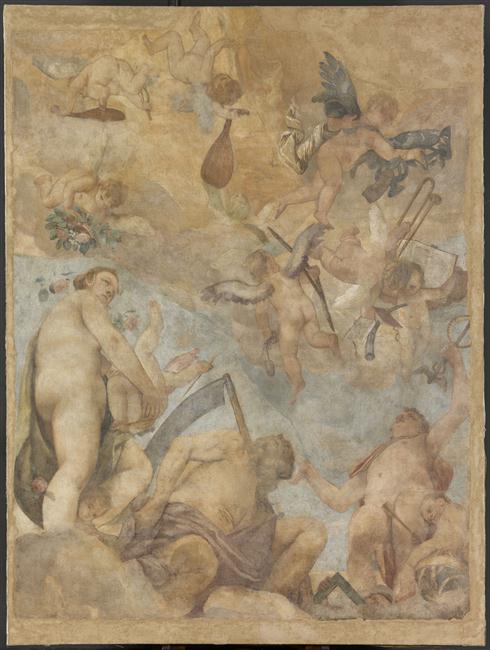
c. 1557—Murano, Italy: Paolo Caliari (also called Veronese) paints The Seven Planetary Gods on the ceiling of the first floor of Palazzo Trevisan. The fresco, which includes a cherub or putto playing trombone, is later transferred to canvas and housed in the Louvre, Paris (see middle-right of below image; public domain).
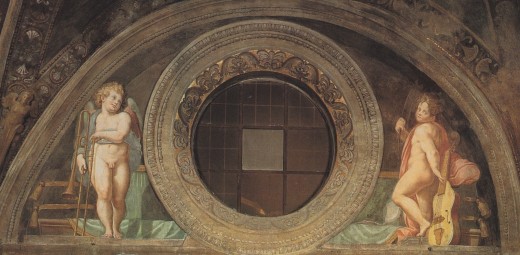
c. 1566—Cremona, Italy: Bolognese artist Orazio Samacchini paints a cherub (putto) holding a trombone in the Church of Sant'Abbondio (see detail below; public domain) (Bandera Fig. 66).
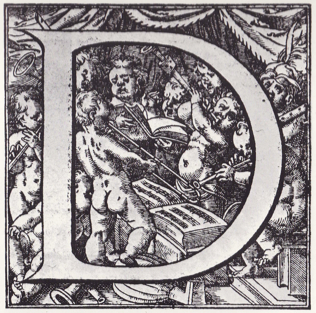
1578—Antwerp, Belgium: A set of masses by George de La Hele includes an image, a large initial D in front of a group of cherub musicians, that features a rear-facing trombone being played by a cherub (also rear-facing). Most of them perform from a central partbook (see below image; public domain; Wangermée vol. 1 167).
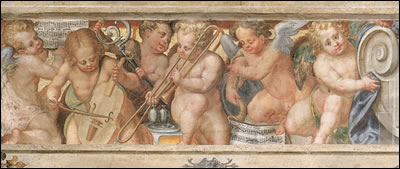
c. 1580—Milan, Italy: Aurelio Luini depicts a cherub-trombonist among other cherub-musicians in his fresco in Milan's San Simpliciano (see below image; public domain) (Kendrick, Sounds of Milan 77).
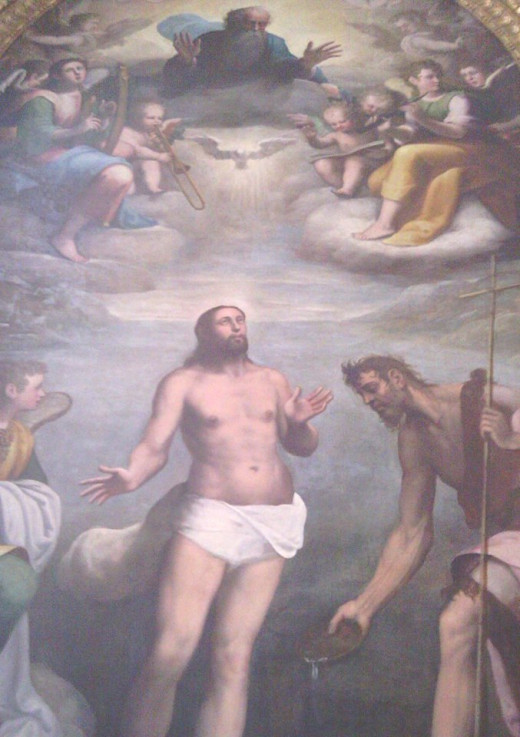
c. 1590—Loano, Italy: Battesimo di Gesu (Baptism of Jesus), a painting by Giulio Cesare Semino located in Chiesa di S. Agostino, includes a cherub playing trombone (see below image; public domain).
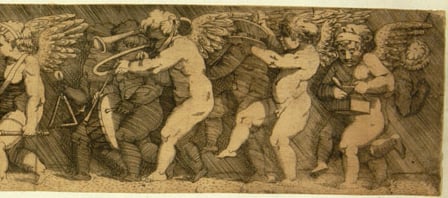
16th century—An anonymous print includes a trombone-playing cherub, or putto (see below detail; public domain) (source: Beaux-arts de Paris).
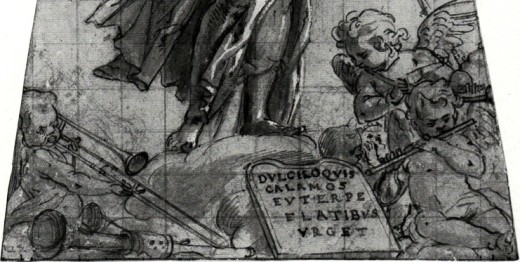
1611—Pieter de Witte (also known as Peter Candid) includes a cherub playing trombone in his drawing, Euterpe. Resting in front of the cherub-trombonist is a shawm, and the instruments being played on the other side of the image are transverse flute and cornetto (see below detail; public domain) (Volk-Knüttel 102).
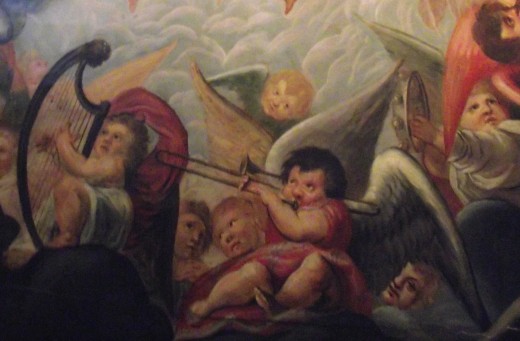
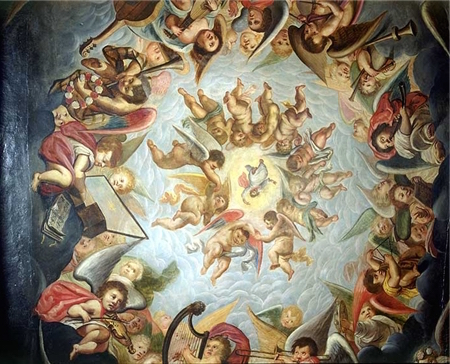
1619—Derbyshire, England: An anonymous ceiling painting in the Heaven Room of Bolsover Castle shows Christ’s ascension, surrounded by angels. The outer circle of angels features angels with several different musical instruments, including trombone (see detail and full image below; public domain).
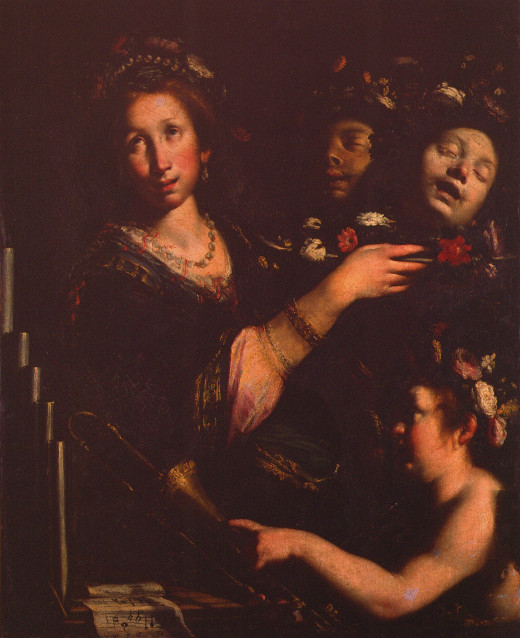
c. 1620—Italy: Italian Baroque painter Bernardo Strozzi includes a putto holding a trombone in the painting, Santa Cecilia con le teste di Valeriano e Tiburtio (see below image; public domain) (The Digital Library of the National Library of France).
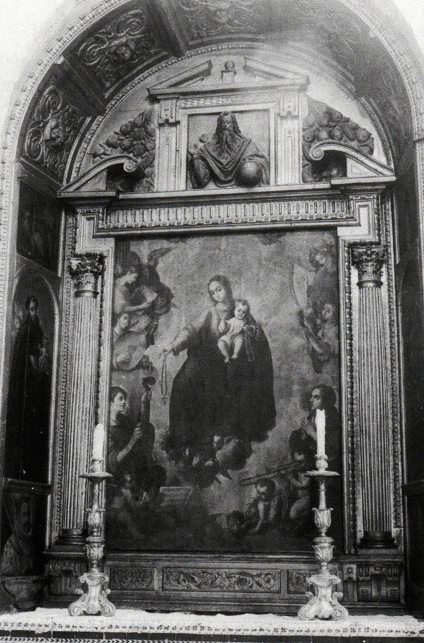
c. 1620-24—Seville, Spain: The altarpiece of the Virgin of the Rosary of the Parish of Santa Ana, probably painted by Diego López Bueno and Miguel Cano, includes a depiction of a cherub playing trombone (see bottom-right of below image; public domain) (Alonso Cano 613).
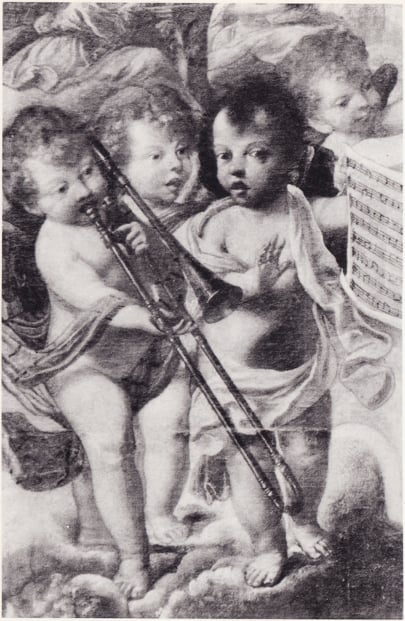
c. 1629—Venice, Italy: Veronese artist Fra Semplice da Verona includes a depiction of a cherub playing trombone in Infant Jesus and Musical Angels, an image framing a pre-existing Madonna in the Convento del Redentore (see below detail; public domain) (Portogruaro, plate 37). Other instruments being played (but not shown in the detail below) include cornetto, viol, violin, and lute.
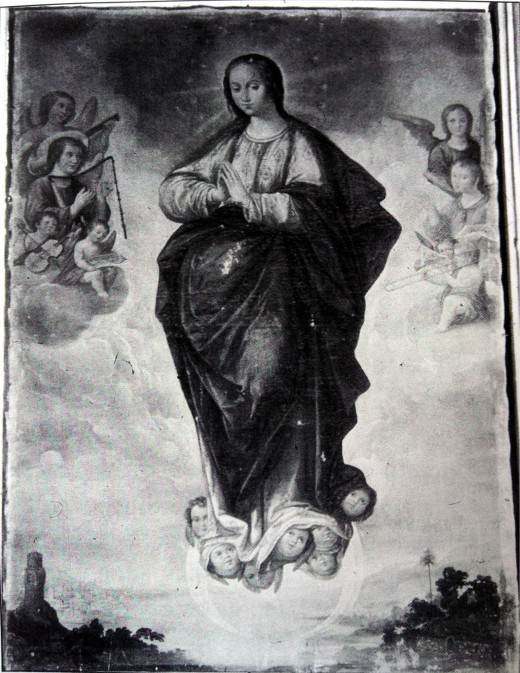
c. 1640—Carmona, Spain: Juan de Castillo’s Inmaculada Concepción in Convento de la Trinidad includes a putto playing trombone (see middle-right of below image; public domain).
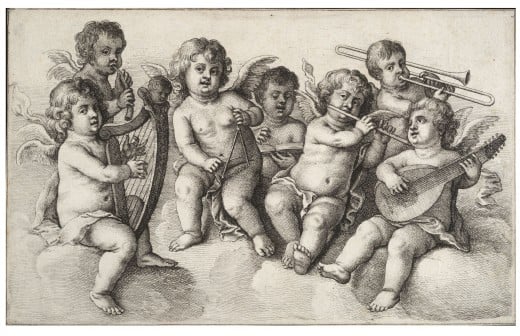
c. 1650—Bohemian artist Wenzel Hollar includes a trombone-playing putto in his print, Concert of Putti in the Clouds (see below image; public domain) (Wenceslas Hollar Digital Collection, University of Toronto, Pl. P500).
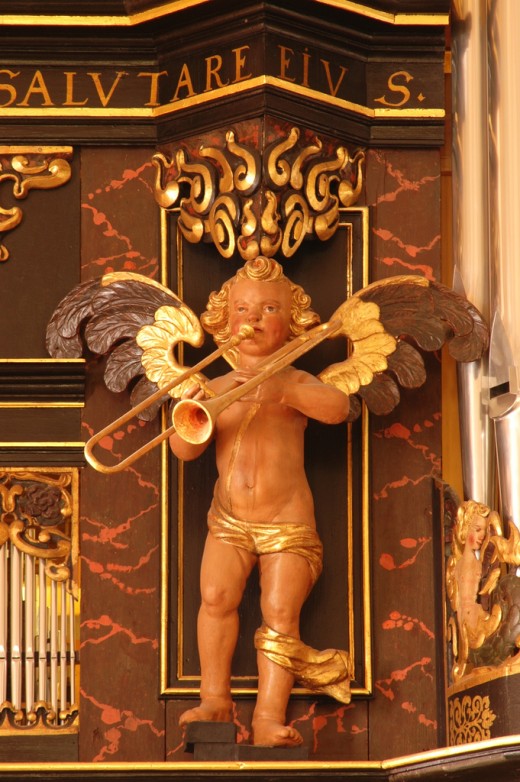
1658—Schöningen, Germany: Jonas Weigel completes the organ for St. Vincenzkirche, which includes a sculpture of an cherub-trombonist on the organ case (see below detail; public domain). The cherub-musician on the opposite side, not shown, plays the cornetto.
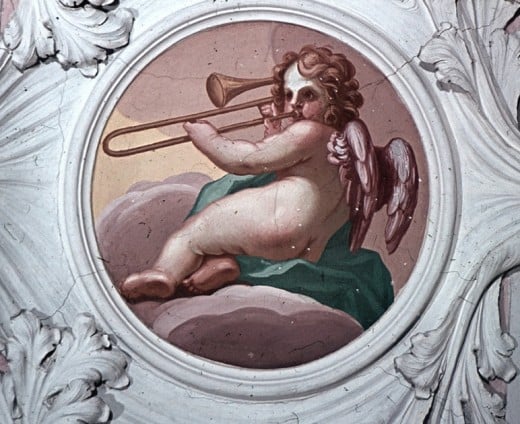
1689—Seville, Spain: The church of the Hospital de los Venerables Sacerdotes, with walls and ceiling painted by Juan Valdés and his son Lucas Valdés, is completed. Among the numerous instrument-playing cherubs depicted on the ceiling is a cherub playing the trombone (see detail below; public domain).
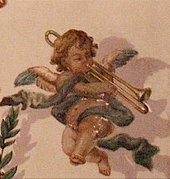
1704-14—Saalfeld, Germany: Carlo Ludovico Castelli paints a trombone-playing cherub in Saalfeld’s Schlosskapelle (see below image; public domain).
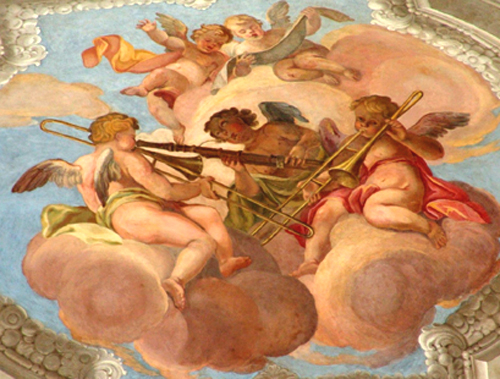
c. 1715—Vienna, Austria: A fresco above the organ loft in Vienna's Peterskirche (St. Peter's church) depicts cherubs playing trombone and bassoon (see below image; public domain).
Sources
Burkhard, Arthur. The Freiburg Altar of Hans Baldung. Munich: F. Bruckmann, 1970.
Kendrick, Robert L. The Sounds of Milan, 1585-1650. New York: Oxford University Press, 2002.
Portogruaro, Davide M da. Paolo Piazza, ossia P. Cosmo da Castelfranco: pittore cappuccino, 1560-1620. Venice: Libreria emiliana editrice, 1936.
Volk-Knüttel, Brigitte. Peter Candid: Zeichnungen. Munich: Staatliche Graphische Sammlung, 1978.
Wangermée, Robert, and Philippe Mercier. La musique en Wallonie et a Bruxelles, vol. 1. [Belgique]: La Renaissance de Livre, 1980.

More Trombone History Hubs
- Angel Trombonists Throughout History: 40 Images
"What do the angels, those heavenly and most perfect musicanti, play other than these? For if we encounter something about music in the Scriptures, we hear either of a trumpet or a trombone (Kuhnau, 28). ... - Christmas Bells Are Ringing: The Trombone and Christmas throughout History
It's early September as I write this, but one of my children recently put up her Christmas list on the fridge. It's never too early, I suppose! Which got me thinking... As I mentioned in another article,... - Females in Trombone History, 1500-1900
The idea that females did not become serious trombone players until the 20th century is a misconception. While many of the visual images shown below are symbolic (e.g., depictions of muses and angels), there... - How to Hold a Sackbut: The Grip of the Early Trombone in Pictures
Occasionally there is discussion about how the sackbut, or early trombone, should be held. Among other differences, in contrast to the modern trombone, the stays on these early trombones are flat, so the... - Super Slides: Trombones with Extension Handles
Before bass trombones had valves to access extra tubing for lower notes, players were forced to use extra-long slides if they wanted to extend the lower register. These slides were long enough that extension... - Sound Qualities of the Early Trombone: 20 Primary Sources
A few years ago I applied for funding to purchase a set of sackbuts, or early trombones, for my university. I decided at the time to do some research, in the form of both recordings and primary sources, into... - Trombone History in Latin America, 1500-1750
Latin America normally gets only a few pages, at the most, in the standard histories of the trombone. It probably deserves more. Records document a significant amount of trombone activity in colonial Latin... - Trombone Names Throughout History
The trombone, an instrument that originated in the 15th century, has a long history of colorful names. What other single instrument can boast nomenclature as interesting and varied as sagbot, shagbolt,... - God Save the King! The Trombone in Coronations throughout History
The trombone has long been associated with special occasions, including water processions, parades of various types, weddings, various religious celebrations, and coronations. Historically, trombones were for... - Trombone History: Trombones in Water Processions
A brief history of the trombone in water processions. Trombone history in the late Renaissance and Early Baroque. - Trombone History: The Trombone in Parades, 15th and 16th Centuries
76 trombones led the big parade! When Meredith Willson penned those lyrics in 1957 for the Broadway musical The Music Man, the author was unwittingly reflecting not just a recent local tradition, but nearly... - Trombone History: The Trombone in Parades, 17th-19th Centuries
This is the second of a two-part series on the history of the trombone in processions. For the first hub, see here. The trend in the three centuries represented below is a general movement from royal and... - Trombone History: A Mischievous Trombonist in Renaissance Italy
Siena, Italy, ca. 1572, from Civitates Orbis Terrarum Sixteenth-century, Siena, Italy, boasted a first-rate musical establishment in both its Palace wind band and its cathedral musical establishment,...